Friday, June 10, 2011

Hiroshima in Half a Day

Arrived in Hiroshima two days ago. By the time I got settled into my hostel (I stayed at J-Hoppers Hiroshima, which was very nice), it was already noon. There wasn’t a huge list of things I wanted to do in Hiroshima so I figured I could get through most of it in one afternoon. The main attractions focus around the memorials to the victims of World War II, particularly the victims of the atomic bomb dropped on Hiroshima. I went to the Peace Memorial Museum, which was very interesting because it gives the Japanese perspective on the war mixed with Hiroshima’s somewhat unique perspective on nuclear weapons. The museum does a good job of demonstrating the extent of the destruction Hiroshima faced when the bomb was dropped. Essentially, everything and everyone was turned to dust. The bomb was actually detonated hundreds of meters above ground, but the sand in the ground melted into something that looks like glass, roof tiles fused together, and glass bottles turned molten. My understanding is that there are only two or so buildings in Hiroshima that are still around from pre-WWII. Here are some photos:

Photos: Various memorials at the Peace Memorial Park.


Left: Fused roof tiles. Right: Glass bowl with sand fused to it, melted glass bottle.


Left: The Hiroshima A-Dome. Right: Watch that stopped when bomb was detonated.

Hiroshima is a city that has really dedicated itself to the cause of world peace, and the city government is very active in advocating for the destruction of all nuclear weapons. The War Memorial Park is a beautiful section of the city carved out by rivers, and you can see several war memorial statues, an eternally burning flame, etc. Very beautiful, and it also serves as a nice, calm area very close to the busy city center. The War Memorial Park and the museum seem to be very popular for elementary school field trips, because everywhere I looked there were many groups of small children in matching uniforms and cute matching hats. I managed to get a great video of Japanese school children ringing what I assume is some sort of memorial prayer bell. Enjoy!


After checking out the memorials, I took a bit of time to walk around downtown a bit, especially the shopping districts. Lots of very cool shops with interesting merchandise.

That night I met up with a friend of mine, Tomo, who lived in the US for two years before returning to Japan in January. Tomo brought along a few friends of his who had graduated from Waseda University, which is where I will be studying when I finish my travels. We all went to this really cool little restaurant where everything on the menu cost 280 yen (roughly 3 US dollars). We drank a lot of beer and Awamori, and we ate TONS of food. The place sounds very cheap, but we ended up ordering such a variety and so many drinks that we all ended up paying about 3,000 yen each. I got to try a lot of very interesting Japanese dishes, which I am planning to post about in the future. The other reason that this restaurant is so neat is due to the way that you place orders… Basically you have a menu and a little electronic wand that looks like a giant pen. You wave the wand over the item you want to order, then over the number of that item that you want, and then over one final place on the menu, and your order is transmitted immediately to the kitchen. Drinks arrive at your table in less than a minute, and food also comes out very quickly, depending on what the dish is.
In general, I found the people of Hiroshima to be exceptionally kind, and they loved talking to an English-speaking foreigner. In fact, while walking to my hostel, an older Japanese woman saw me looking at a map, so she ran over to me and asked if she could help me find something. I already knew where I needed to go, but she insisted on walking 5 and a half blocks with me to my hostel! We talked along the way, and once we got to my hostel she turned around and walked back the way we had come. I am constantly amazed at the hospitality that the Japanese show me.

Tuesday, June 7, 2011

A farewell to Tokashiki Island, one of the most beautiful places on Earth

So a little more about Tokashiki Island… Tokashiki is home to only about 700 people. The entire island has a single stop-light, and the barber comes from the mainland for two days out of each month to cut everyone’s hair. There is no high school, so at age 15 teenagers have to move to Naha or somewhere else to continue their educations. Unsurprisingly, few make it back to Tokashiki. I think I was able to relate to this rural, small-town feel because of my own experiences in rural settings.

Two days ago marked my last full day on Tokashimi Island, and I think I spent the time well. I started by watching the sunrise on the beach, which was amazing. Then, after breakfast, some of the local guys had to go do some work on the docks that morning, and they invited me to come along with them to do some sea fishing while they worked. So I spent a couple of hours that morning fishing. We caught a few medium-sized, brightly colored fish. What was cool is that you could often see the fish as they were approaching your bait. I hooked one fish so big that it broke my line! Kuni, Seichi, and the other local guys I had been hanging out with thought that was very funny. I thought it was funny too, but also a little frustrating. They took this opportunity to teach me how to vent my frustration with a Japanese curse word, “bukaros,” which I think means “son of a bitch.”


I spent a couple of hours that afternoon sunning on the beach (actually, I fell asleep listening to the ocean.) I still can’t get over how beautiful Aharen beach is. Really an amazing place.

That evening I was invited to go grab dinner and drinks with the guys I had been fishing with. They were very concerned about the fact that I usually don’t eat pork or beef, so they kept ordering vegetarian dishes for everyone to share. We of course drank plenty of “beeru” and also had a delicious drink called “Awamori.” Awamori is an especially pungent kind of sake that, to my knowledge, is only produced in Okinawa. I’ve been told that you cannot buy it in many other countries, including the US, because it has a very high alcohol content for a rice wine. It has a very strong taste, but I found that I really like it! The locals mixed it with water (“mizhu” in Japanese), but I preferred it straight. They were amazing that I liked the taste and would drink it by itself.
(Kuni-bo, Seichi, Akito, and most importantly, Awamori!)

Midway through our meal, another local guy who had stayed at the docks to do more fishing came into the restaurant to show us he had just caught a pretty big fish. To my surprise, they handed the fish to the restaurant owners, and they had fried it up in no time flat. It tasted amazing, and obviously you can’t get fish any fresher than that.

After a few hours of eating, drinking, and chatting with other locals who came in, we decided to drive to the other side of the island to the town of Tokashiku (so far I had been staying in Aharen.) We went to what looked like the only open establishment that was still open at 11pm, a karaoke bar and restaurant. A few of the locals we met in Aharen had joined us, so we were up to about 9 people at that point, and we all piled into a private karaoke room for more drinks and singing. Needless to say, I didn’t get to sleep until about 2am!

To put it simply, my time spent in Tokashiki was absolutely amazing. Not only was the scenery gorgeous and the food delicious, but the local people were some of the most kind, genuine, and sincere people I’ve ever had the pleasure of meeting.

Miho and Shinnoske, for instance, are a newlywed couple (as of March this year!) who I bonded with on several occasions. Shinnoske runs a hostel on the island and does a number of other odd jobs, including helping Miho run her newly remodeled restaurant/bar that is just by Aharen beach (called Octupus Garden, after the Beatles song). They are both damned good cooks, and Miho knows how to make an excellent drink. Kuni, another local guy I had the pleasure of getting to know, is the son-in-law of the older couple who own the hostel I stayed at. At first, I was a little intimidated by him; he is a very big guy (he practiced sumo at one point, and he also competes in arm wrestling tournaments), but he turned out to be one of the gentlest,
kindest people I met in Tokashimi. He called me “Friend Jeemy” and “English teacher.” Seichi, a transplant from Tokyo who came to Tokashiki only a month ago for work, liked to joke around with me and call me “Charao” (translation: playboy). When no one else was paying attention, Seichi gave me a beautiful seashell as a going-away present; he said he had spent hours that day diving in the ocean to find it.

During our night out eating and drinking, Kuni, Seichi, and the others absolutely refused to let me pay for anything. I was a guest to them, and they said if I wanted to pay, I have to come back to Tokashiki and take them out! All of these people, and the people at the hostel I stayed at, gathered together when it was time for me to leave and waved goodbye until my car was completely out of sight. Saying goodbye to all of them was such a strange feeling. In only a matter of days I felt like I had become a part of this community, and they all seemed very sad to see me go. I certainly was sad to go, and I couldn’t help feeling a little worried that my amazing time spent on Tokashiki was going to overshadow the rest of my time in Japan. I guess this just means I’ll have to work extra hard to have fun as I continue my travels!

Okay, long post I know, but just a quick update on where I am at the moment… so again, two days ago was my last full day on Tokashiki. Yesterday I took the ferry back to Naha and immediately caught a flight to Fukuoka. It was rainy in Fukuoka, and I wasn’t in the mood to do touristy stuff, so I spent the evening wandering around back alleys (getting lost on more than one occasion). And this morning I boarded an express train headed for Hiroshima, and I should be there shortly. Planning to do a lot of touristy stuff there, so I’ll keep you updated!

Left: Ocean view from higher up. Right: Tokashiki rice paddies.

Sunday, June 5, 2011

My FIRST (and LAST) Scuba Diving Experience

Went scuba diving today! It was an amazing experience, and I saw some really cool things, but I don’t think it’s something I would ever do again. What really freaked me out was the way my instructors decided the dive was over…. More on that later. In general though, I couldn’t entirely get past the fact that I felt completely helpless being so far underwater.
Adjusting to the depth took me longer than I expected… my two dive instructors seemed to be able to descend and ascend almost instantly with no problems, but I could only go a couple of feet without having to equalize the pressure in my ears. When we finally got down to the bottom (only about 5 meters, which is not very deep at all really), my left arm went numb. Very odd.

Anyway, the things you see down there are pretty amazing. See anemones, coral, tons of fish. There was a chance, supposedly, that I could see a 3 meter-wide stingray. I didn’t see it, and I’m not sure that I’m sorry about that lol… I was feeling helpless enough without being next to something bigger than me.

But I got to see some beautiful, neon-colored fish, and it was really neato. And I did begin to get comfortable down there after a bit… in fact, I was swimming around so fast at one point that one of my instructors wrote on his underwater eraser board, “You fast, slow please.”

But every bit of comfort that I’d amassed about the whole situation disintegrated in a matter of milliseconds not long after that. So, to explain a bit, when I signed up to do this dive, I just assumed that it would last a set amount of time. Not so. Apparently, the sign that the dive is over is when your air gauge goes into the red “danger zone.” After we’d been down there for a while, my dive instructor taps me on the shoulder and pushes the OMG YOU ARE GOING TO DIE gauge up to my mask. As I said earlier, it took me ages to get down to the bottom, equalizing every foot or two; well, after I saw that my air tank was on the verge of empty, please believe that I made it back to the surface in record time.

Not the best way to end the dive… but it gets worse from there. Once back to the boat that we dove from, I managed to remove all of my gear except my wetsuit and mask. I thought I would spend a little time snorkeling around, looking at the coral from further away. “Much more comfortable,” I thought. “Yes, this is what humans were meant for: staying near the surface, without a million tons of pressure sitting on top of you.” Well I don’t know if it was the rapid ascent, the waves, or the entire scuba experience, but it was only a few minutes before the dizziness, fatigue, and nausea hit me. The onset was sudden, and it really knocked me for a loop. For a second I wasn’t even sure I would make it back to the boat by myself, but I managed to do that. The general feelings of crappiness went on for hours… once I got back to my hotel, I took a hot shower and then slept for almost three hours. I woke up feeling like I had run a marathon, and I still felt so dizzy that I wasn’t sure I could walk straight. Luckily, I got a lot better after I had something to eat.

So I’ve come away from this experience with a couple of insights about people who dive regularly.
++First, concerning people who dive for work, research, science, etc: I really respect you for being able to do this regularly and at much greater depths. Despite the fact that I love doing research, I now know that I could never be a marine scientist. I don’t know how you folks do it.
++But concerning people who do this regularly for “fun”: I’m not sure I trust you anymore. In fact, I’m going to recommend that you seek out a certified mental health professional ASAP, because you must be completely insane to enjoy this.

ANYWAY… Hope you enjoy the photos. I have one more full day left on my Island Tropical Paradise, and I’m going to spend it the way humans were meant to spend such days: drinking cocktails on the beach. Over and out!

Saturday, June 4, 2011

Tokashiki Island: Tropical Paradise

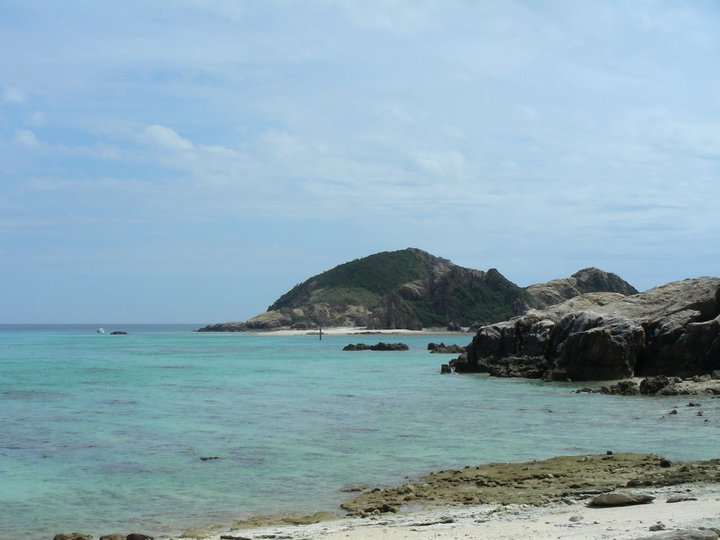
Today is my second day on Tokashiki Island, and so far I'm loving it. Unlike Naha, Tokashiki seems much more traditional, with far fewer English-speaking people. The total population is about 700 tops, the locals tell me. I get the feeling that this is where the Japanese that live in Okinawa go to get away from the foreigners. The locals here are really lovely people, and the views are amazing. I had an entire beach to myself for most of the day yesterday. Pictures below!

Today I will be taking a boat out to an uninhabited island not far off the coast of this island, and I'll be going scuba diving for the first time ever-- very excited! While I was eating dinner last night, my scuba instructor introduced himself to me. He then lead me over to the computer, where he used Google Translate to express the following: "Tomorrow I worry translation error. Breathe." That was more than a little disconcerting, but he also gave me a DVD about scuba to watch last night, so I think I'll be fine. Wish me luck!


Friday, June 3, 2011

Oh the perils of communal restrooms...


Japanese cartoons can make anything funny.

Just made it to Tokashiki Island


The ferry ride from Naha took about 35 minutes. Gorgeous views on the ride out. Naha left a lot to be desired-- too many foreign tourists, too much American military presence. But Tokashiki, on the other hand, seems very traditional. Saw lots of rice paddies on the drive to the beach house. Enjoy the photo!

Welcome to Japan!

Arrived at Japan via Narita International Airport yesterday at about 5pm Japanese time. Made it through customs and to my hotel in Shabuya with minimal trouble. Despite being exhausted after the flight, and despite not getting to my hotel until nearly 9pm, I couldn’t wait to go exploring. The cool thing about Tokyo is that it is truly an all-night city. This was a weekday, past 9pm, and there were still shops and restaurants open on every street I saw; too cool!

I didn’t think about this until I got here, but this is the first place I’ve ever been where I truly couldn’t fit in no matter how hard I tried. Now I’ve traveled all over the world… throughout Europe, Central America, Australia… but everywhere I’ve been before Japan, I could easily pass as a local if I tried. Even in Mexico and Costa Rica, if I wore sunglasses and didn’t talk, people would approach me assuming I was a local. But not in Japan. I look very different from everyone around me, and it is very noticeable. So why am I writing about this? Because I never really thought about how terrifying this experience can be. As soon as I got on the train realized I hadn’t seen another person who looked anything vaguely like me since the airport, I kind of had a mini freak out moment. For no logical reason, everyone suddenly seemed very hostile-looking. I was terrified to speak to anyone or even look at anyone.

Luckily, however, I quickly found myself in a situation where I needed help: I needed to make sure I was on the correct train. I gave the international gesture for complete helplessness to the girl sitting next to me (puppy dog eyes, of course), pointed to my Tokyo rail map, and started talking. Her reaction completely calmed me down: she seemed genuinely excited to be talking to someone in English! Not only did she ensure me that I was on the correct train, but this interaction also gave me the courage to start talking to other people.

This brings me to my first of several GENERAL IMPRESSIONS OF JAPAN (based on just a single day’s time in Tokyo: The Japanese in general are super excited to talk to a Gaijin (ie, “stupid white boy.”) I’m not exaggerating when I say this… If they know any English, they will literally knock each other over to be the person who gets to help the Gaijin. Let me give you an example… after I got off my first train and walked to the next train station (getting lost along the way, of course), I accidentally made my way into the office of the more expensive of two rail lines. As soon as I started speaking in English, about 5 workers ran up to the counter, crowding around the teller I just happened to approach. I explained where I was trying to go and on which rail line… and this teller jumps up, runs to my side of the counter, and asks me to follow him. He then proceeds to walk me over to the other ticket office (which is kind of his company’s competitor company). He then shows me how to buy a ticket, shows me where to get on the train, and tells me where to switch lines. I was completely blown away by this… and I can’t even tell you how many more times in the past 24 hours Japanese people have gone completely out of their way to help me (and yes, I’ve needed a lot of help… hah!)

Okay, some more, and hopefully briefer, GENERAL FIRST IMPRESSIONS OF JAPAN (based on just one day in Tokyo):

Tokyo is the first city I’ve ever been to where I’ve felt completely safe while wandering down random alleyways. Not only will you feel comfortable doing this, but you’ll pretty much be forced to if you want to see even a fraction of what Tokyo has to offer. Most of the restaurants and bars seem to be these intimate little places tucked into sidestreets and alleyways that may only see a car occasionally.

Rice in Japan tastes significantly better than any rice I’ve ever had in the US or anywhere else. And I’m just talking about plain old white, steamed rice.

Japanese bathrooms are TINY! But tiny in a not realy uncomfortable way… more just tiny in a funny way.

Tokyo’s public transportation system is AMAZING. I’ve traveled to many of the biggest cities in several of the most prosperous countries in the world, and I have never seen a public transportation system that runs as flawlessly as Tokyo’s. First of all, you can get anywhere in this huge city by taking a train (buses not really necessary in my experience thus far, but I’ve also heard that the bus system is good.) Second, everything is presented in multiple languages. Every train I’ve been on at least has digital displays and voice announcements in both Japanese and English, and some even include Chinese and other languages. Trains seem to really leave on time, and they also seem to come very frequently. I generally hate public transit because I consider it to be expensive, dirty, and unreliable, but I really like Tokyo’s public transportation system thus far.

Despite the fact that everything is small and compact in Japan, their domestic airlines give you more leg room and more comfort than any US carrier I’ve ever flown on. I’m writing this blog post on my flight from Haneda to Okinawa, and I’m flying on a Japanese airline called Skymark. I got a discount plane ticket. Not only was it cheaper than a US ticket would have been to go the same distance, but the seat gives me more leg room than I’ve ever had on a plane before (excluding flights where I sat in an exit row.) The plane is clean, and the stewardesses are super nice (one heard me speaking English on the phone—I was actually cursing out my credit card company for putting a block on my cards even though I told them I would be travelling internationally, which is another story altogether—and came up to me just to talk in English with me.) Why are US airlines so expensive and yet so shoddy in terms of amenities and service?

Japan doesn’t really offer separate accommodations to non-smokers. Every restaurant I’ve been to allows smoking, and I haven’t seen a “non-smoking” section yet. Many states in the US have banned smoking in restaurants, and even in states that haven’t, I never sit in smoking sections, so this was very weird to me at first. In fact, in one restaurant I confused an ashtray for a bowl… luckily I noticed someone smoking a few tables down before I tried to put food in it!

The Japanese love pork. During my first meal here, I had to draw a picture of a pig and put a big “X” over it, and draw a picture of a chicken and give the waitress a thumbs-up. She was able to point out one item on the menu that was just chicken; big chunks of fried chicken. (And I must say, it was delicious!)

The Japanese love vending machines, maybe even as much as they love pork. I went into a restaurant for breakfast today, sat down at the counter, and looked over at the waiter. He gave me the craziest look… and it took me a second (and watching someone else order their food) to understand why. Basically, this restaurant had a “vending” machine near the restaurant entrance. The machine had pictures of different meal options on it. You were supposed to put in money, push the buttons to choose one or more meals, take the ticket that the machine spits out, and then give that ticket to the waiter when you sat down. It sounds a bit weird, but it is actually a really ingenious system… it means that the waiter doesn’t have to spend as much time because your order is already written down and payed for. I really like it because I hate handling money after I wash my hands… money is dirty, I wash my hands right before I eat, and I don’t want to touch money right when I’m about to eat or have just finished eating.

And lastly, Tokyo made me realize that I don’t necessarily hate rain. Now I might come to regret writing this if I happen to find myself in the middle of a monsoon in the coming months, but let me explain… During Berkeley’s rainy season, rain generally equates to “cold,” “discomfort,” “want to stay inside,” and “pure evil,” in my opinion. In Japan, it is currently nearing the end of the rainy, and my first night in Japan was marked by a slow but steady drizzle (the same kind of rain that generally plagues the Bay Area.) But because it was warm, this rain was actually quite enjoyable… the rain was calming, it made the air smell clean, and it just made exploring the nighttime streets of Tokyo even more fun. So thank you, Tokyo, for helping me remember those WARM rainy days that I grew up with in Mississippi. And Berkeley, if you’re reading this… please take a freaking hint.

Okay, that’s enough for now. I haven’t been taking many photos, but I’m planning to start doing that when I get to Okinawa and flip the “tourist mode” switch. Just to let you know what I’ll be doing in the coming days… I’ll be in Naha tonight, and in the morning I’m taking a ferry to Tokashiki Island (ferry is the only way I know how to get there, and it only runs like twice a day, so I’m guessing this island is fairly remote.) I’ll be staying at a beach hotel there for a couple of days, just relaxing, taking in the sun, and oh yeah, going scuba diving for the first time ever! (very excited about that). After a couple of long days in tropical paradise, the plan is to take the ferry back to Naha and catch a flight to Fukuoka. I’ll explore Fukuoka that night only and the next day begin making use of my Japan Rail Pass (which you should look into if you ever plan to come to Japan.) The train will take me to Hiroshima, Osaka, Kyoto, and then back to Tokyo (stopping for a few days in each city.) I’ll try to update you regularly throughout my trip!